Rubrique 05
How the courts are arranged, and what a docket is
What a docket is, how the Law Court, Superior Court and District Court divide the work, and what the specialised dockets of the Maine Judicial Branch handle.
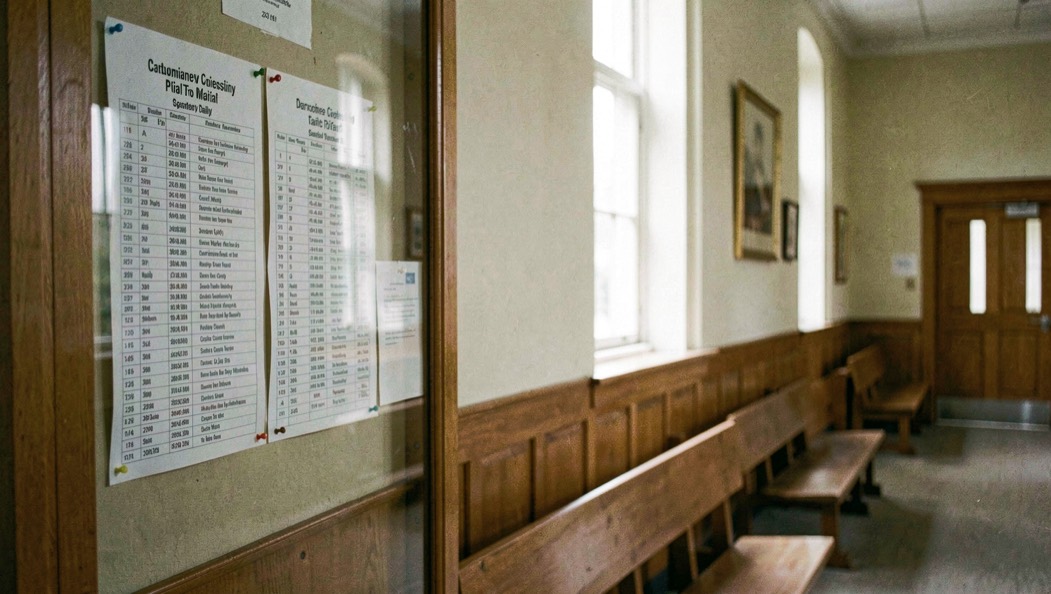
The word docket does most of the confusing work in this area. It is not a courtroom and not a case: it is the running list on which a case is entered, and courts run several of them at once, some of them specialised.
Maine’s own courts page is quiet on the point. It uses the word once, for a statewide business docket, and publishes no access rules for dockets at all, so the questions a reader tends to bring, what may be read and by whom, find no answer there. The folio opens with what a docket is and with what the page leaves unsaid.
Three levels, described in the Judicial Branch’s own words
The Supreme Judicial Court sitting as the Law Court decides appeals on questions of law arising in civil actions and criminal trials. The Superior Court is where almost all civil and criminal matters may be tried. The District Court takes lesser criminal offenses, civil actions and family law matters. Those are the descriptions published on courts.maine.gov, read on September 6, 2026.
The Branch sorts its courts by one question: what kind of matter lands where. An appeal on a question of law goes up to the Law Court, almost any civil or criminal matter may be tried in the Superior Court, and the lesser offenses, civil actions and family matters sit in the District Court. The fuller map, still in the Branch’s own words, is drawn in how the Maine courts fit together.
The specialised lists
Alongside the three levels the Judicial Branch runs a Family Division, a Traffic Violations Bureau that handles the state’s traffic infractions centrally, Treatment and Recovery Courts, and a statewide Business and Consumer Court docket. Each takes a defined slice of the work, and a reader who knows which slice can stop looking in the wrong index.
Where do the papers themselves live?
Count the levels and the lists together and the courts page names seven bodies. A filed paper in Maine lives with whichever of the seven its kind of matter assigns. The page read on September 6, 2026 names them all and publishes no rule for reading the files they hold, which is a gap a reader meets early. What is known about finding a filed paper is gathered under where case papers live.
The courts page on courts.maine.gov collects every name printed above, and it takes a few minutes to read. A reader can hold any sentence in this folio against it. The three pages that follow keep one order: the word first, the structure second, the files last.
In this folio
-
What a docket is, and what it is not
A docket is the dated list a court keeps of a case. Maine's own courts page uses the word once, for a statewide business docket, and publishes no access rules for dockets at all.
Rubrique 05
-
How the Maine courts fit together
The Maine Judicial Branch sorts its courts by one question: what kind of matter lands where. A reader's map of the published structure, from the courts page read on September 6, 2026.
Rubrique 05
-
Where case papers live once a matter is filed
A filed paper in Maine lives with whichever of seven named bodies its kind of matter assigns. The Judicial Branch page read on September 6, 2026 names them all and publishes no rule for reading the files they hold.
Rubrique 05